

KOTORI — Festival Mobile Order
● My Role
Product Designer
Sole End-to-end product design for live festival operations.
Period: 2025 July- Present
Phase: 0-2
Discovery
Feature Scoping
Mobile App Designs
UI Solutions
On-site Observation
Iterative Validation
● About
A web-based order management system that helps festival vendors receive, prepare, and manage KOTORI orders efficiently while handling busy booth operations.
● Background
As Smiles grew as a major festival sponsor, we worked more closely with organizers and discovered a key problem: long food queues were hurting the visitor experience and limiting vendor sales. This led us to create KOTORI.
● The Problem
The Vendor Challenge

01 — PROBLEM
Managing Two Order Flows
Vendors must handle walk-in and KOTORI orders simultaneously

02 — PROBLEM
High-Pressure Operations
Vendors need a simple flow to receive, prepare, and complete orders quickly.

03 — PROBLEM
Unstable Festival Connectivity
Crowded venues can cause slow or unstable internet
● Main Objective
Make every important action understandable within seconds.

The vendor experience keeps the complete order lifecycle visible from a compact mobile device, prioritizing speed, visibility, and minimum interaction so booth staff can focus on food preparation.
INCOMING ORDER → CONFIRM → PREPARE → READY → PICKUP → RECEIVED
03 — Design Principles & Order Management
Designed for fast-paced operations
Design Principles
Accessible and UX First
simple flows that help every vendor quickly set up their store, manage menus, and process orders.
Key Features
Incoming orders at a glance
New work surfaces immediately.
Clear order numbers
Fast recognition for staff and customers.
Menu and quantity clarity
No ambiguity before preparation starts.
Status visibility
Current state stays legible during the rush.
Primary actions stay close
Ready, Received, and Cancel never disappear.
Active vs. completed orders
The queue remains focused and scannable.
Usability Testing - Phase 1 & 2
UX Design Result

Phase 1
Vietnam Festival Osaka 2026
Goals:
System Check
Flow check
On-site observation
Phase 2
Vietnam Festival Tokyo 2026
Goals:
Large scale check
Connectivity check
UI Design





01 — THE VENDOR PROBLEM
Designing for a crowded booth, not a back office
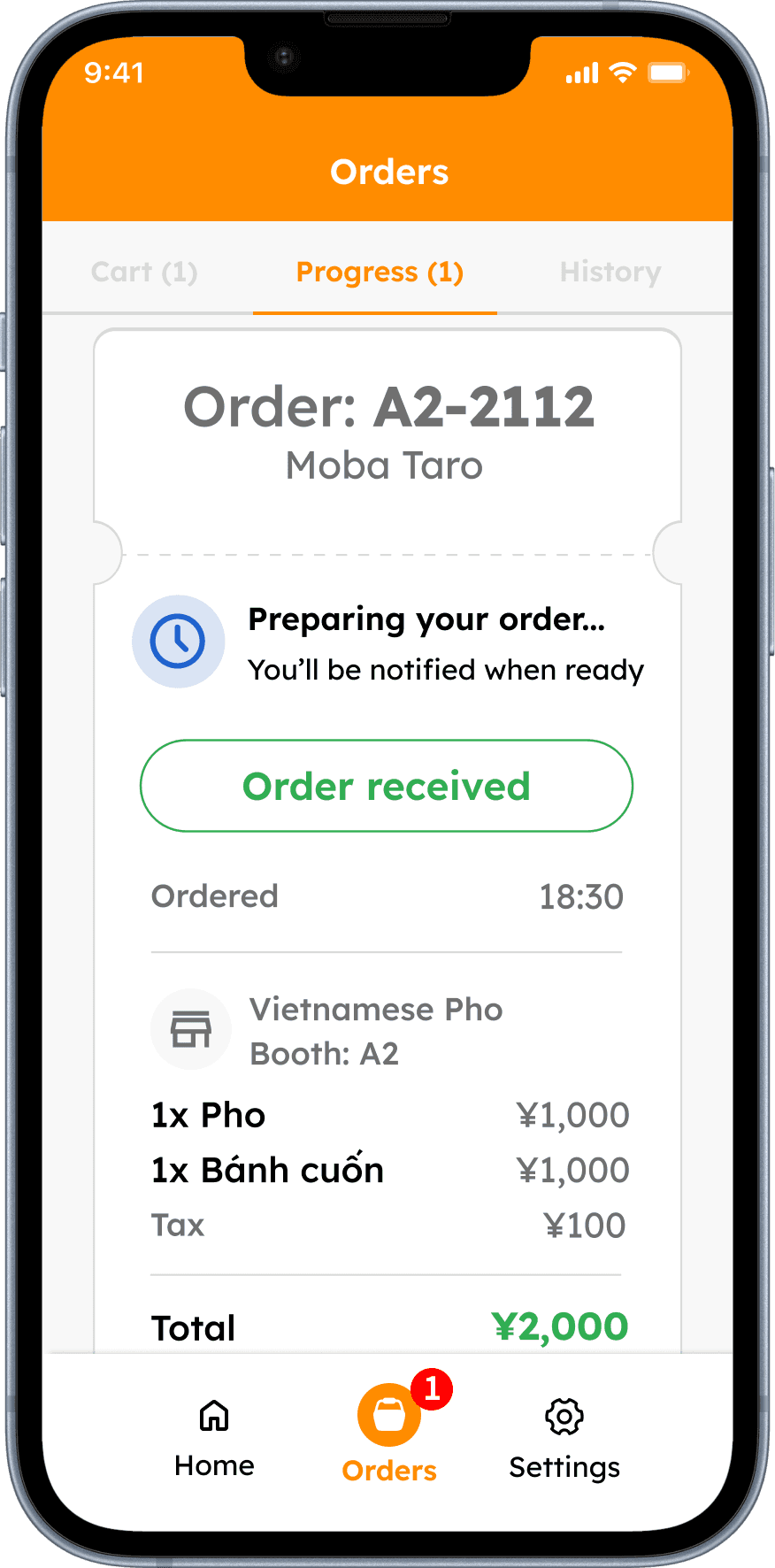
Festival vendors need to manage walk-in customers and digital orders simultaneously in a fast, crowded environment. Live testing showed that staff could miss incoming orders, struggle with status management, and spend too much time navigating the interface instead of preparing food.
Missed incoming orders
Digital orders could be overlooked during peak service.
Order IDs were hard to scan
Critical Received and Cancel actions were difficult to find.
Monitoring ownership was unclear
Staff responsibilities for monitoring KOTORI were not always assigned.
Vendor setup took too long
Menu registration and store setup competed with physical booth preparation.
Connectivity interrupted operations
Unstable venue internet risked breaking the order flow at peak times.
Our Solutions
UX Design Result

Fast & Accessible User Experience
Designed for Outdoor Festival Use
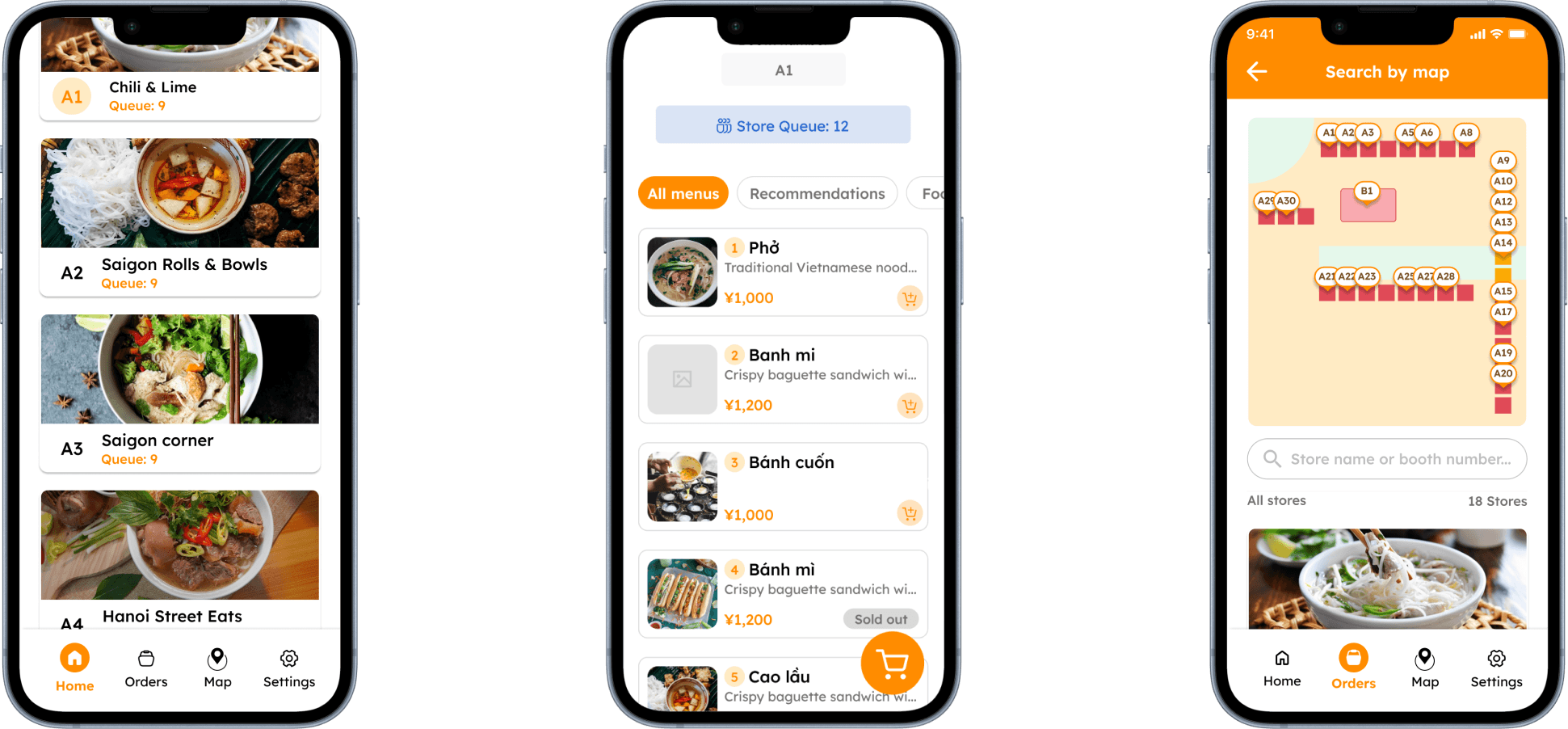
Since the event environment is crowded and the outdoor lighting can be very bright, users are less likely to read long text. Instead, they rely more on visuals, clear icons, and images to quickly understand information at a glance. Customers need a fast, clear, and trustworthy web app for this new app.
Select Store
Select Menu Items
Search by Map
[Select Store] Prioritize images and visual cues so users can quickly understand information with minimal reading in a crowded outdoor environment. [Select Menu Items] Allow users to add items directly from the menu, reducing steps and making ordering faster. [Search by Map] Let users explore and order from stores through the map, while clearly showing where to pick up their orders.

Log in Page
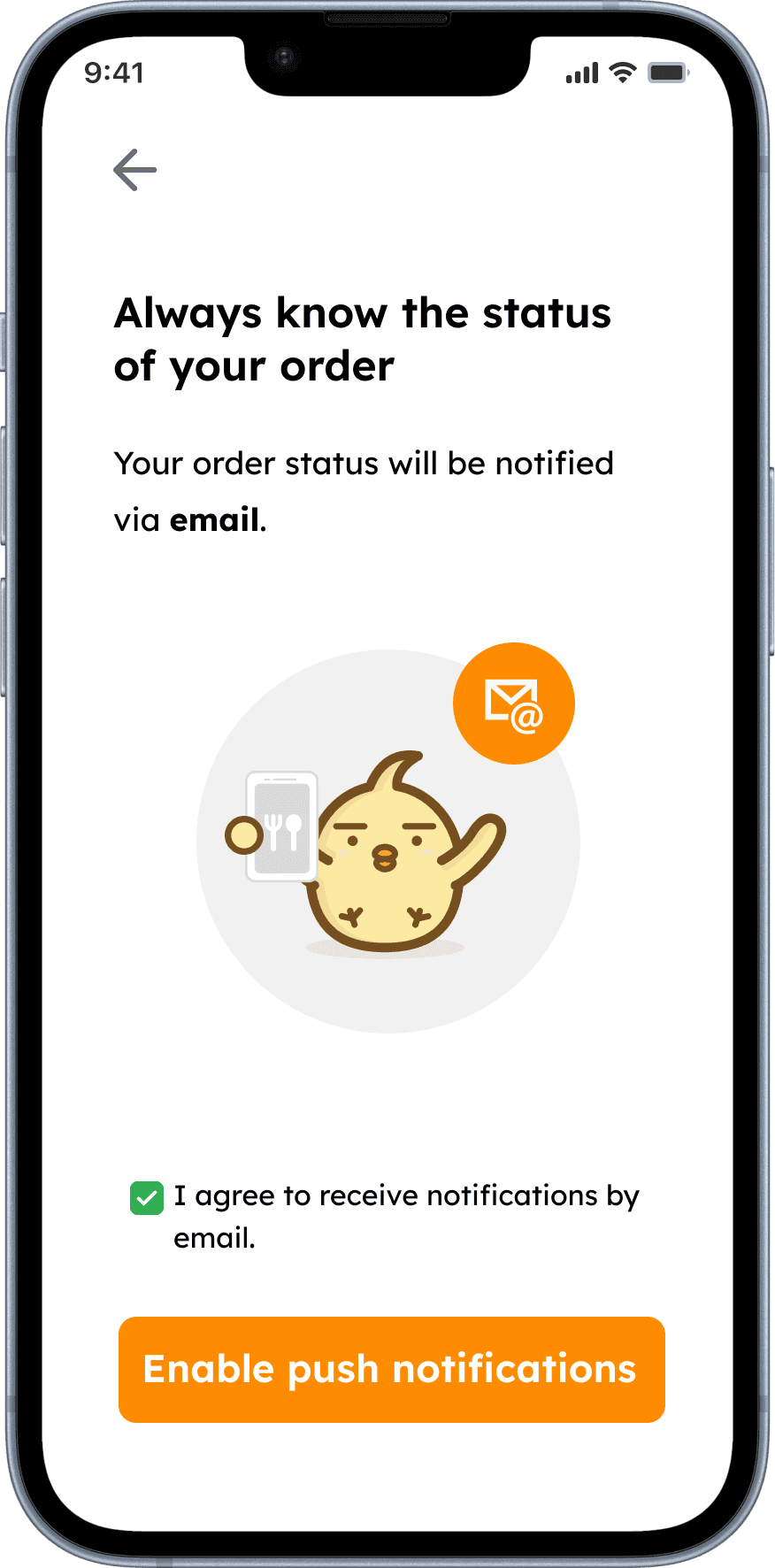
[Log in] Use email-only login to reduce friction while allowing users to save and access their order information.
04 — MENU & STORE MANAGEMENT
A digital storefront alongside the physical booth
Before the festival, vendors need to prepare store information, menus, product images, pricing, availability, sold-out states, and store status. Live testing made clear that setup must be fast and reusable, especially for products with many variations.
DESIGN DIRECTION
Make setup faster and reusable, with simpler product registration and presets for commonly sold items.
05 — PHASE 1: LIVE VENDOR TESTING
Vietnam Festival Osaka 2026
The first live deployment showed that vendor UX directly impacts the customer experience. Staff could miss notifications, struggle to complete pickup, and face limited preparation time alongside menu editing, image handling, tax setup, and network instability.
KEY INSIGHT
The vendor interface could not behave like a traditional back-office system. It needed to work as a fast operational tool while staff were cooking, serving customers, and managing a crowded booth.
Faster order handling
Simplified order information, improved hierarchy, clearer status actions, and faster access to active orders.
Easier store operations
Improved menu management, clearer sold-out controls, simpler store switching, and stronger staff responsibilities.
Better event readiness
Improved vendor onboarding, clearer operational guidance, consistent pickup setup, and preparation for connectivity issues.
07 — DESIGN RESPONSE
Faster decisions at the booth
Based on Phase 2 observations, the vendor order interface was redesigned around faster decision-making, clearer action placement, and standardized physical operations.
Clearer actions
Place Ready, Received, and Cancel directly within the order workflow.
Faster recognition
Use large, shorter order numbers with clearer status hierarchy, more spacing, and visible product context.
Standardized operations
Align QR placement, pickup lanes, booth signage, order handling, and Wi-Fi preparation.
08 — FINAL VENDOR FLOW
A workflow that stays clear under pressure
Order Received → Staff Reviews Order → Prepare → Mark as Ready → Customer Arrives at KOTORI Pickup → Confirm Pickup → Mark as Received
Key learnings
Vendor UX directly impacts customer UX. Speed matters more than feature density during a festival rush. Operational design goes beyond the screen, and scaling from 2 to 23 booths requires standardized systems and guidelines.
12 — OUTCOME
KOTORI’s vendor experience evolved from a basic order-management interface into an operational tool designed around the realities of festival booths. By combining vendor UX improvements, clearer order management, and standardized physical operations, KOTORI supported 23 active booths, 1,118 transactions, and ¥1.61M+ in sales during Phase 2.
Bhaswara Maralaut
More projects and experiences are always on the way.
Let's keep in touch!